
Resources
Donations are Welcome
"Sharing the Merit, even if they give just one cent, people should have the motivation of putting a drop of water in the ocean. A drop of water on its own will easily evaporate, but in the ocean it will always remain." There are many ways you can contribute to WelcomingBuddhist for our future plans.
Calendar
Nothing from September 12, 2026 to September 19, 2026.
Search
To not become happy because of praise, To not become unhappy because of blame, To support one's own good virtues, This is the character of the supreme being.
If the intention is good, the levels and paths are good. If the intention is bad, the levels and paths are bad, Since everything depends on intentions it is important that we make them positive.
Do not do anything harmful to one another, do only what is good. Discipline your own mind to subdue negative emotions.
Do no evil whatsoever, practice virtue perfectly, tame your mind completely. This is the teaching of the Buddhist doctrine.
-
Author Archives: Ven. Lopon Osel
During the summer months.2013
There will be no organized classes during the summer months. If there is a change and a class becomes available, we will post a new message. Lama would like to take a short break to concentrate on his own self … Continue reading
The Proper Buddhist Attitude to Listen.
Everything is circumstantial and depends entirely on one’s aspiration.
The right attitude combines the vast attitude of the bodhicitta, the mind of enlightenment, and the vast skills in means of the Secret Mantrayana attitude.
THE VAST ATTITUDE OF THE BODHICITTA
There is not a single being in samsara, this immense of ocean of suffering, who in the course of time without beginning has never been our father or mother. When they were our parents, these beings’ only thought was to raise us with the greatest possible kindness, protecting us with great love and giving us the very best of their own food and clothing. Continue reading
The Excellent Path to Enlightenment
At Highland High School Salt Lake City. Teaching Beginning march 20–2013 may 8 end Class.
The Excellent Path to Enlightenment: A Short Preliminary Practice. The essence of all Buddhist teachings includes Nongdro, which is fundamental to all levels of Buddhist practice.
As normal sentient beings, we have many obstacles coming from inner mind emotion. How can we deal with this emotion? This emotion antidote comes from Buddha Wisdom teaching.
just like an expensive car which is useless without gas, if we do not learn from this spiritual teaching and practice, we continue to unknowingly make mistakes, and it is impossible to become a good human being.
The Excellent Path to Enlightenment: Oral Teachings on the Root Text of Jamyang Khyentse Wangpo is available at amazon.com (opt). Continue reading
Beginning Teachings of Nagarjuna, Letter to a Friend
Instructor: Lopon Osel, Professor of Buddhist Philosophy.Teaching and meditation classes will be held at the University of Utah, 2013- Feb. 25th Monday. 6:00PM – to 8:00pm. Nagarjuna, a 7th century Indian Buddhist Master composed this root text.
The text expounds the Buddhist View, Meditation, and Action, written in the form of advice given to a friend, with a commentary by Jamgonmipham Rinpoche.This is such a wonderful teaching. Class: Winter Session 2, at the University of Utah
Continue reading
A prayer my Own Faults.
A Prayer To Recognize my Own Faults and Keep in Mind the Objects of Refuge,
by kyabje Dudjom Rinpoche. I pay homage to the guru. Shakyamuni, Victorious One. Supreme guide of the realm for this fortunate aeon, Sons of the Victorious one, assembly of noble Bodhisattvas who tame sentient beings,
Lord guru, matchless savior of beings in the dark age, the three Roots and oath-bound Dharma guardians, again and again, I ask from my heart, recalling you with longing and one-pointed mind, Please turn your attention toward me. Continue reading
Entering the City of Omniscience Aspiration Prayer.
Entering the City of Omniscience Aspiration Prayer for Actualizing Words of Truth.
I offer homage to the source of an ocean of accomplishments: the Masters, the Three Jewels, and the Bodhisattvas. I take refuge in you.Grant your blessings,
I pray! In all my future lives, may I gain a precious human birth complete with all the eighteen freedoms and advantages, and may I become the student of an authentic master.
May I train my mind through learning, contemplation, and meditation – the source of higher rebirths and definite goodness.
May I follow Buddha’s Precious Teachings! May I renounce worldly activities – the root of all Dharma Practice Continue reading
The Barbarian
BUDDHIST TERMINOLOGY: THE BARBARIAN
In terms of secular western thinking, the word “barbarian” often conjures images of a cruel, brutish, merciless savage who, armed with a club or other means of violence, is intent on wreaking havoc. At the least, the word is associated with a person who may be from an undeveloped, uneducated area or country and regarded as lowbrow, crude, and vulgar.
However, in the Buddhist lexicon, the meaning of “barbarian” signifies something quite different. Rather than a person with sights set upon inflicting mayhem, the Buddhist term is more akin to what westerners think of as a “heathen”, hedonist or non-believer. It refers to “jungle mentality”, one who has the body of a human but the limited view of a jungle animal. Continue reading
COMING HOME – the cremation of Khandro Lhamo
Kyabje Dilgo Khyentse Rinpoche, was a distinguished teacher, of among others the Dalai Lama. He has been reincarnated as the Yangsi or ‘newborn’. The young Yangsi is one of the leaders presiding over the cremation of Khandro Lhamo, who in his past life had been his sang yum.
We see the extensive and colorful cremation, presided over by the most distinguished leaders of various Tibetan schools, partly because Khandro Lhamo was the Sang yum of Dilgo Khyentse Rinpoche, head of the Nyingmapas.
It may well be one of the last times the leaders of a Tibetan Buddhist cremation were actually born in Tibet. The importance of direct transmission during the rituals on to the new generation is therefore given extra weight by this cremation. Trulchik Rinpoche, Dzongsar Khyentse Rinpoche, Tenga Rinpoche, Yangsi, Neten Choling, as well as daughter Semo Chime Wangmo and Shechen Rabjam Rinpoche share their views. Continue reading
Short Sadhana Nongdro CDs now available
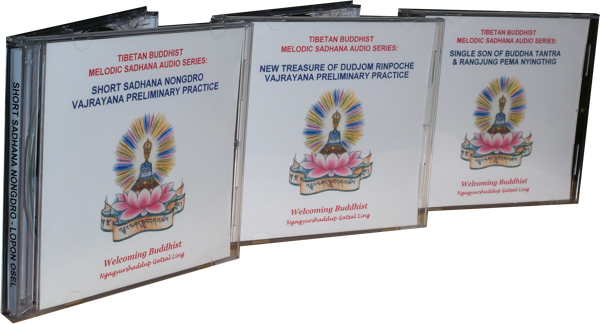 Nongdro is the essential training of the Longchen Nyingthig tradition of the Nyingma lineage. Althoug Nongdro literally means “preliminary practice”, it is the foundation of all practices: the sadhana is a complete path in itself, conclusively leading us to the highest goal.
Authentic Buddhist melodic sadhanas emanate from enlightened lineage masters, without the contamination of self-created ideas of the ordinary or negative minded. They carry the power of true Blessing. Those created by ordinary minds have neither real power nor blessing: they are like the imagined alluring sounds of a cascading waterfall falling upon deaf ears. We are happy to send these CDs. Please contact us so that we can provide them to you.
All the sadhanas listed on this website will be coming soon on CD.
These are available for a donation. Please click this link to learn more. Continue reading
Heart Treasure of the Enlightened Ones Teachings.
At Highland High School Salt Lake City. Teaching Beginning Jan 23- 2013 and going through mrach 6 end. Tibetan Buddhist An introduction, philosophy and meditation is the ancient science of developing the positive mind of wisdom; wisdom is purity and true happiness.
Ven. Lopon Osel, Professor of Tibetan Buddhist Philosophy and Meditation. The teaching of Buddhist view, meditation and action is one of the most profound because sentient beings have eighty-four thousand types of negative emotions.
There fore, the Buddha taught eighty-four thousand antidotes to these negative emotions. The book used in class is,“The Heart Treasure of the Enlightened Ones” commentary by H.H.Dilgo Khyentse Rinpoche (available at amazon.com) is a key to the Buddha’s teachings. If we don’t learn to practice love andcompassion, our negative emotions increase, leading to suffering. This class (session II) is a continuation of Fall Session I. Continue reading
